
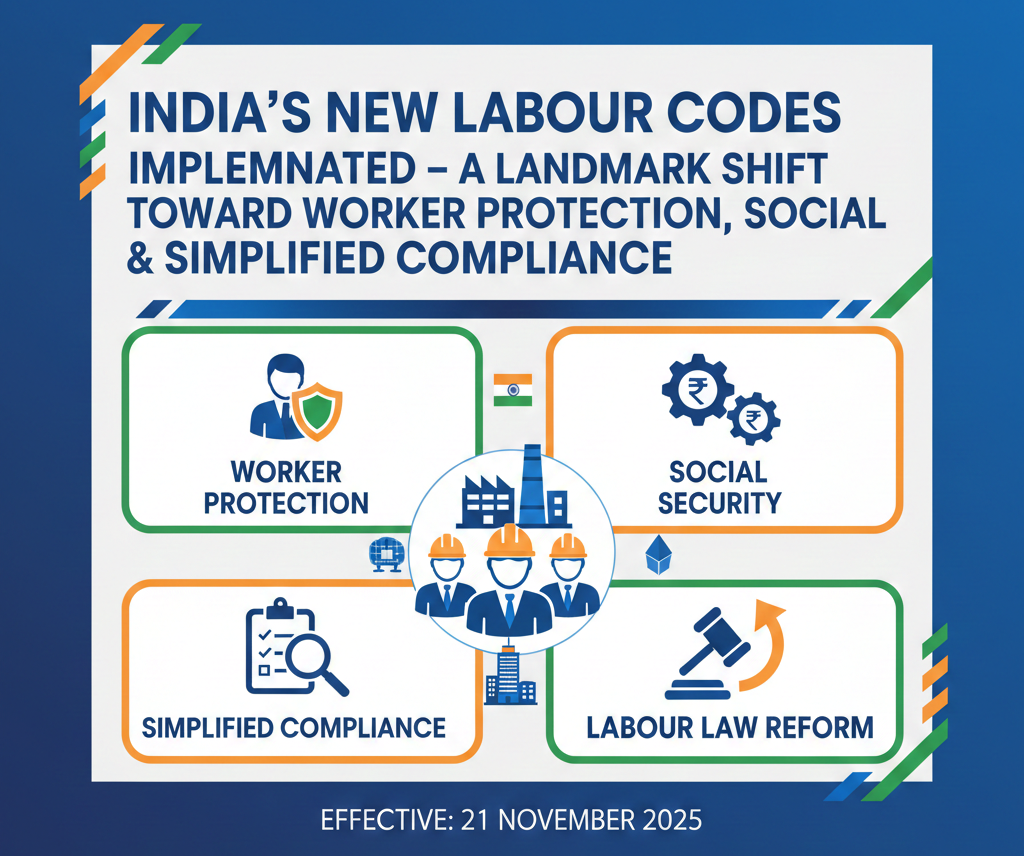

The Government of India has officially implemented the long-awaited four Labour Codes with effect from 21 November 2025, marking the biggest labour-law transition in independent India. This reform consolidates 29 central labour laws into a streamlined framework with the goal of ensuring better wages, greater safety, universal social security, and reduced compliance burden—both for workers and industry stakeholders.
The implementation addresses a long-standing demand to replace outdated, fragmented labour legislation dating back to the pre-Independence era, aligning India with contemporary global labour standards and modern work structures.
The Four Labour Codes Now in Force
- Code on Wages, 2019
- Industrial Relations Code, 2020
- Code on Social Security, 2020
- Occupational Safety, Health & Working Conditions (OSHWC) Code, 2020
These codes form a unified legal ecosystem governing wages, industrial relations, working conditions, and social security–ensuring a future-ready and rights-focused labour environment.
Key Systemic Improvements: Before vs After the Reform
| Earlier Framework | After Labour Code Implementation |
| No mandatory appointment letters | Appointment letters mandatory for all workers |
| Minimum wages for limited scheduled employments | Universal minimum wage applicable to all sectors |
| Limited social security | Universal PF, ESIC, Insurance & pension coverage |
| Fragmented compliance & multiple licenses | Single Registration, Single License, Single Return |
| Restricted participation of women in several jobs & night shifts | Women allowed in all sectors including night shifts with safety guarantees |
| No mandatory free health screening | Free annual health check-ups for workers aged 40+ |
Major Beneficiary Segments: What Changes for Workers
The Press Release highlights sector-wise improvements. Key examples include:
✔ Fixed-Term Employees
- Same benefits as permanent workers
- Gratuity eligibility after 1 year (earlier 5 years)
✔ Gig & Platform Workers
- Defined legally for the first time
- Welfare contribution by aggregators 1–2% of annual turnover
✔ Women Workers
- Equal pay mandate
- Night shifts allowed across all industries with consent & safety:
- Transport
- CCTV
- Security presence
✔ Youth & Entry-Level Workers
- Mandatory appointment letter
- Guaranteed minimum wage and paid leave
✔ Unorganised, MSME & Migrant Workers
- Broader coverage for minimum wages, canteens, restrooms & safety
- Portability of benefits across States
Changes Affecting Employers & Industry
Employers must realign policies, HR formats, payroll systems and compliance documentation as:
🔹 Timely wage payment is mandatory
🔹 Double overtime wage entitlement enforced
🔹 Digital Employer-Worker Compliance Framework introduced
🔹 Inspector-cum-Facilitator model replaces punitive inspection system
🔹 Appointment letters and record-keeping formats to follow uniform standards
This marks a shift from punitive enforcement toward compliance-support and standardisation.
Industrial Relations & Dispute Resolution Changes
- Two-member Industrial Tribunal model introduced for faster adjudication
- Workers may approach tribunals directly after conciliation
- Stricter timelines for dispute settlement
Occupational Safety & Working Conditions
- National OSH Board to set uniform safety benchmarks
- Mandatory safety committees for establishments with 500+ workers
- Enhanced safety norms for mines, hazardous industries, plantations & digital media workforce
Implications for the Indian Workforce
With implementation of the Codes:
- 64% of India’s workforce (previously informal or partially regulated) now enters a structured labour governance ecosystem.
This includes:
✔ gig workers
✔ contract workers
✔ migrant workers
✔ platform economy participants
✔ export sector labor
✔ MSME workforce
Compliance Reality & Transition Phase
The Government will now frame corresponding Rules, Schemes, and Notifications, while current laws continue in effect until the transition completes.
🔎 Critical Considerations & What Remains to Be Seen
- Implementation varies across states — each State must notify rules under the Codes; until then, some provisions might be in a transitional stage.
- The real impact on cost of labour vs. competitiveness will depend on how employers restructure pay-scales and allowances (e.g. balancing CTC, basic pay, allowances).
- For informal sector, MSMEs and gig/platform workers — actual ground-level enforcement and registration of benefits will decide the effectiveness of reforms.
- Legal challenges are likely — especially from trade unions, worker groups, and states that may resist certain provisions (e.g. changes in lay-off approval threshold, fixed-term employment, collective bargaining rights).
Conclusion
The 2025 implementation of India’s Labour Codes is a transformational moment in workplace governance—balancing worker rights with ease of doing business. The reforms:
- Expand protections across both formal and emerging digital economies
- Create uniform standards across states and industries
- Simplify compliance for employers
- Strengthen transparency, safety, and worker dignity
As an advocate and labour-law professional, this phase presents a crucial responsibility:
interpreting, advising and guiding both employers and workers through the compliance transition to ensure smooth implementation and legal readiness.